
 Inquire
 Apply
Apply Give
Give My Wakefield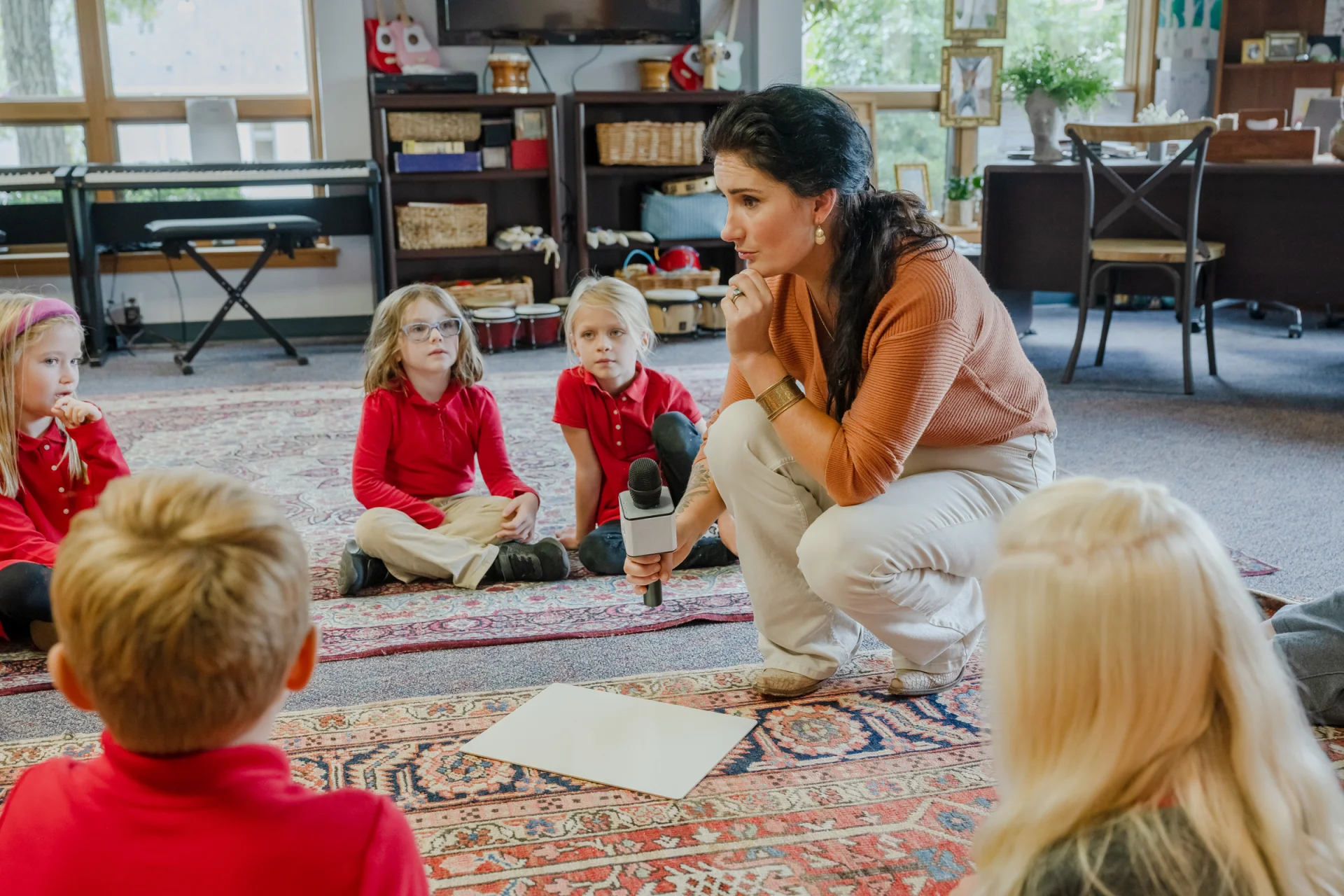
Playing by Ear: How the Freedom to Explore Grows Confident Musicians–and Confident Kids
November 1st, 2024



Playing by Ear
How the Freedom to Explore Grows Confident Musicians–and Confident Kids
By Tutt Stapp-McKiernan
Published in: Warrenton Lifestyle Magazine - November 2024, p. 14 & Haymarket Gainesville Lifestyle Magazine - November 2024, p. 12
“If I asked the faculty to come in my classroom and do even half of what I ask the kids to do, they’d fight me all day! But the kids? They just come in and do it!”
—Bess Putnam
Bess Putnam, the second-year Lower School music teacher at Wakefield School who was named Lower School Educator of the Year last spring, has designed a classroom environment so inviting as to make anyone want to start singing, dancing, and playing some music–all of which her students are invited to do each class period. Gazing around her room filled with color, texture, soft light, and especially, musical instruments, she says, “Most children are ready to jump in!”
Each music class for grades JK-3rd grade involves four typical, required elements–instrument exploration, vocal technique, body rhythm, and classical appreciation–but delivered with Ms. Putnam’s unique perspectives and priorities. Both as a professional musician and as a lover of old-time bluegrass and string-band music, Ms. Putnam shapes her students’ experiences to share the fun and empowerment she herself enjoys through music and performance.
Music studies for Ms. Putnam’s K through 3rd grade classes are themed (currently they are learning about the music of the Farm Aid movement of the 1980s), and “jumping in” can involve either small group work at one of the room’s Research Centers, featuring both books and manipulatives around the current theme, or time to explore musically on any of the room’s many instruments–yes, the students are free to play piano, banjo, a recently-acquired upright bass, a washboard, or whatever the special “instrument of the day” is.
All instrumental learning is done “by ear,” meaning that students are figuring out for themselves how to make the instruments make the sounds they want them to. All students get a chance each class period at playing in a trio, with Ms. Putnam on guitar, while each child is given individual instruction. A long-term ambition of Ms. Putnam’s is for each student to be part of a string-band trio, with all of the groups getting to perform at a Farmer’s Market in honor of their Farm Aid theme!
 “My goal for every student is to connect to the music. So, whether we are singing about potato farmers, listening to Chopin, or performing a Chickasaw stomp dance, foundational understanding is crucial to those connections,” Ms. Putnam says. “I want them to touch and hold as many [instruments] as possible, so they don’t imagine that these are sacred objects that are not for them…It’s lovely that music is revered, but we don’t want it revered so much that we think we can’t participate in it!”
On rare occasions, the amount of “jumping in” that Ms. Putnam’s class encourages can feel a bit overwhelming for some students–but in those cases, she says, the music usually shows the way to confidence.
When a couple of students felt some hesitation last year, for example, that feeling unexpectedly disappeared for good when the class sang the song “Country Roads” together for Earth Day. For whatever reason, she says, that song “reached into those children and completely got rid of any distrust they had had…and suddenly they were asking to sing songs, and asking to play instruments…That tells me, number one, there’s something very special about that song, but number two, the power that there is for music to really change [a child’s] heart and open something up.”
Other Articles to Consider...
 Jun23Curiosity, Meaning, and Service: Rachel Squire Munson ’06 Addresses the Class of 2026
In her Commencement address to the C...See Details
Jun23Curiosity, Meaning, and Service: Rachel Squire Munson ’06 Addresses the Class of 2026
In her Commencement address to the C...See Details Apr6Scenes from School: "Words and Ideas Can Change the World"Part of our Scenes from School series,&n...See Details
 Apr1Strengthening Leadership to Support Wakefield’s Growing VisionWakefield School is strengthening its le...See Details
 Apr1From the Owl's Nest: Familiar Faces Worth Celebrating (Spring 2026)
The Spring 2026 edition of From the ...See Details
Apr1From the Owl's Nest: Familiar Faces Worth Celebrating (Spring 2026)
The Spring 2026 edition of From the ...See Details


 News
News Thought Leaders


