
 Inquire
 Apply
Apply Give
Give My Wakefield
"Hands On the Book": Parent Support for Early Literacy
November 1st, 2023



"Hands on the Book"
Parent Support for Early Literacy
By Tutt Stapp-McKiernan
Published in: Warrenton Lifestyle Magazine - November 2023, p. 16 & Haymarket Gainesville Lifestyle Magazine - November 2023, p. 18
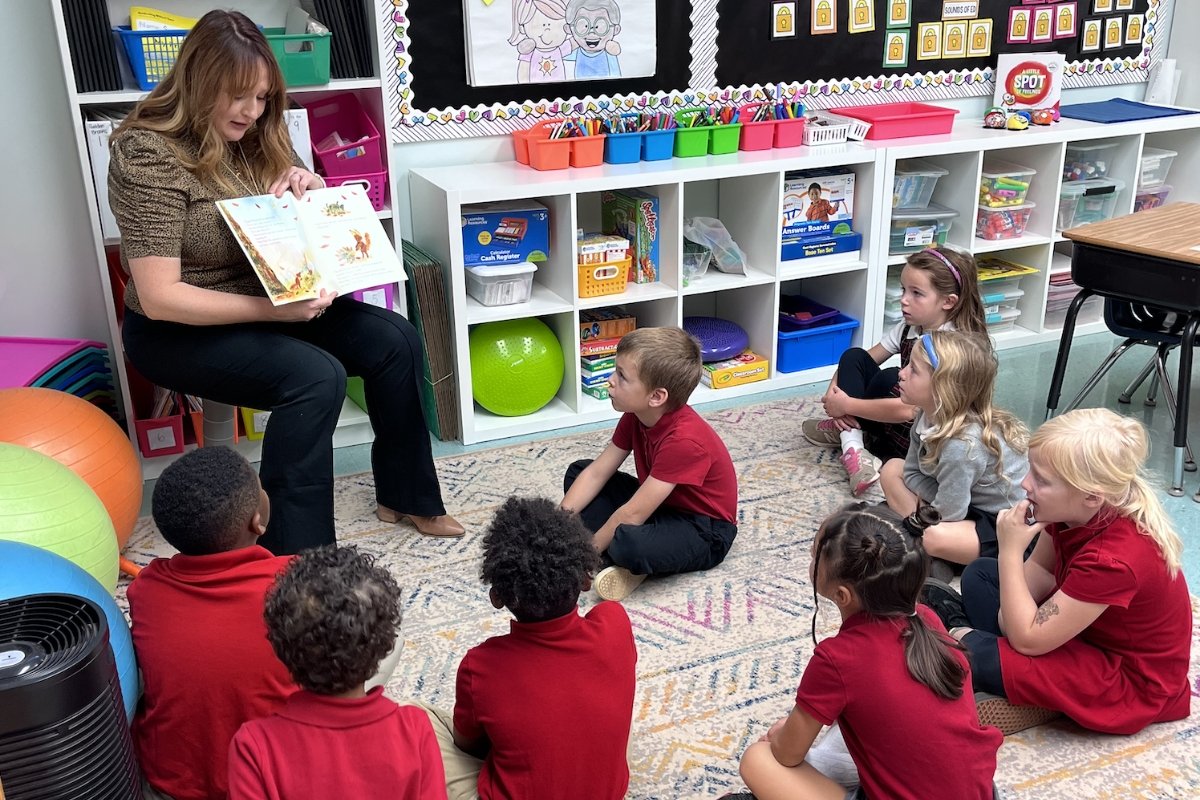
“Put down the electronics and go old-fashioned: read a book together and have a conversation! I want us to not lose the beauty of connection that can happen when you have hands on the book in front of you, on the couch, with your child.”
—Mrs. Sabrina Finn
According to Mrs. Sabrina Finn, one of two first-grade teachers at Wakefield School in The Plains, Virginia, “We don’t call them ‘sight words’ anymore—we don’t want students to look at a word and try to memorize what it is. We are breaking down the sounds!”
Like her fellow first-grade teacher Ms. Kathryn Mullett, Mrs. Finn spends a lot of time talking about and playing with sounds as part of her students’ earliest literacy lessons.
“We spend a lot of time on phonemic awareness—learning to recognize the sounds that we hear,” says Mrs. Finn. “We pound out the words and tap out the sounds—we ask ‘What sounds do you hear in that word?’ and ‘What letters represent those sounds?’ I will speak a sentence and ask them, ‘How many words do you hear in that sentence?’”
And like Ms. Mullett, Mrs. Finn says the best help parents can give is to read aloud: “From as young as you can to as old as they want to, I’d say read at home. And read with them! Some of the best things are having authentic conversations about the stories.”
Ms. Mullett adds, “My big thing is that parents get so excited when their kids start to read that they stop reading to them! Brain research supports and proves what we’ve always known intuitively: that reading aloud matters, even after children begin to read on their own.”
In addition to reading aloud every day, how else can parents support early literacy and early reading? Here are some of Mrs. Finn’s and Ms. Mullett’s top suggestions:
Model the habit of reading.Turn off the TV! Let your children see you reading, even if it’s only for 10 minutes (though 30 is better!). If you’re not a big reader—well, “fake it till you make it!” If you enjoy sports, then just pick up a sports magazine—it can be anything! The point is that they see that you have a passion, and that you read about it.
Let your children read a variety of genres, being sure to welcome in books that they like. Dog Man, Captain Underpants—it really doesn’t matter how silly a book might seem, as long as a child likes it. Above all, you want reading to be fun!
Explore your public library with your children. Amazing things are going on in local libraries! Being in that environment, choosing their own books and looking after them, teaches respect for books and exposes them to a culture of respect for books.
For reading on their own, reading physical books (as opposed to listening to “audibles” on a Kindle or iPad) supports brain development. Your senses are engaged; you physically turn the page to move the story along; you use your imagination to “hear” and picture the story. Audibles are fine for occasional use, say for a long car trip, but they are no substitute for actual reading.
Play with language at home. Playing rhythm and rhyming games, clapping along, singing, and hearing poetry read aloud are all ways to help children hear and enjoy the actual sounds of language.
“All children will learn to read, because they are motivated to please,” says Ms. Mullett, “but if they don’t actually enjoy it, then after a couple of years their interest can wane. The most important thing is helping your child to associate reading with fun and to find joy in reading!”
Other Articles to Consider...
 Jun23Curiosity, Meaning, and Service: Rachel Squire Munson ’06 Addresses the Class of 2026
In her Commencement address to the C...See Details
Jun23Curiosity, Meaning, and Service: Rachel Squire Munson ’06 Addresses the Class of 2026
In her Commencement address to the C...See Details Apr6Scenes from School: "Words and Ideas Can Change the World"Part of our Scenes from School series,&n...See Details
 Apr1Strengthening Leadership to Support Wakefield’s Growing VisionWakefield School is strengthening its le...See Details
 Apr1From the Owl's Nest: Familiar Faces Worth Celebrating (Spring 2026)
The Spring 2026 edition of From the ...See Details
Apr1From the Owl's Nest: Familiar Faces Worth Celebrating (Spring 2026)
The Spring 2026 edition of From the ...See Details


 News
News Thought Leaders


