
 Inquire
 Apply
Apply Give
Give My Wakefield
“Leave Those Kids Alone”: Trusting in the Power of Curiosity-Driven, Self-Directed Learning
May 1st, 2024



“Leave Those Kids Alone”
Trusting in the Power of Curiosity-Driven, Self-Directed Learning
By Tutt Stapp-McKiernan
Published in: Warrenton Lifestyle Magazine - May 2024, p. 10 & Haymarket Gainesville Lifestyle Magazine - May 2024, p. 14
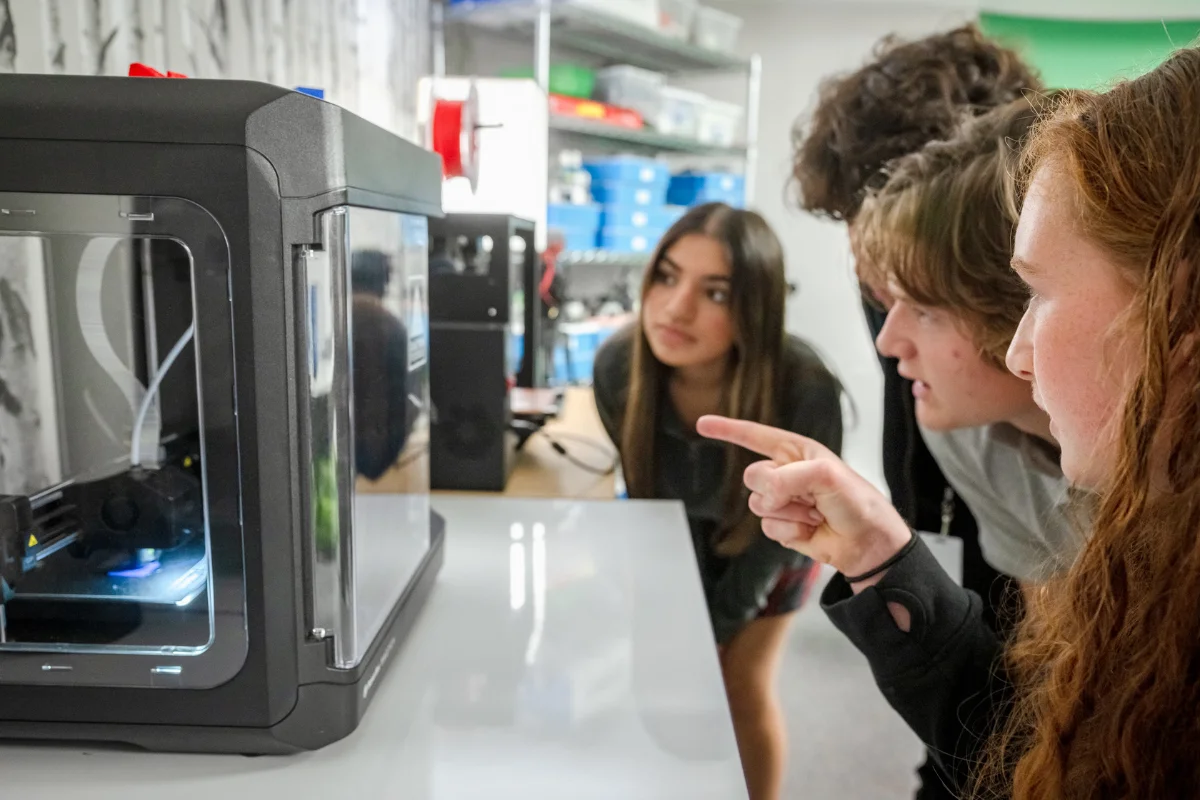
“While I don’t plan on going into a career focused on my independent-study topic, I have thoroughly enjoyed this process and I hope to bring this work into my future interests.”
—Wakefield Junior Hayden Faulkner
Early childhood education pioneer Maria Montessori famously believed that children are self-educating if provided with the right environment and the right tools and resources. In other words, fill a room with the right combination of irresistible, interesting objects, activities, and books, add in a trusted (and non-interfering) adult in a rocking chair to provide calm reassurance and to answer the occasional question, and children will set to and discover everything about the world that the room’s resources can offer. Little children, Maria Montessori said, want to know! Often the best thing we adults can do is get out of their way.
High school students, it turns out, can be not so very different from pre-schoolers in this wonderful way. In other words, fill a school with the right environment, the right tools and resources, and the opportunity to explore, and you will quickly see that high schoolers, too, want to know! Often the best thing we adults can do is get out of their way, too. And the perfect opportunity to see this phenomenon at work is for a school to make a robust independent study option available to its high school students.
At Wakefield School in The Plains, independent study options have long been available, but they have special relevance today. While the Early Childhood program at Wakefield is not Montessori-based, the Montessori ideals of curiosity-driven, self-directed learning are increasingly central throughout Wakefield in light of the school’s recent reimagining and restating of its mission—“to foster the character, curiosity, and clear voices the world will always need.”
Wakefield’s Upper School Course Catalog states, “By ensuring that students both pursue their already-existing passions and also uncover and develop new and unanticipated interests and potential, the Wakefield course of study is designed to fulfill Wakefield’s vision of developing [students] who feel empowered to take ownership of their unique learning experiences.” This reflects the school’s belief that, pursued within the context of a well-rounded curriculum, independent study both honors and rewards curiosity, by deepening student discovery in areas of passion and by encouraging and supporting confident and independent intellectual exploration.
A glance at three student independent studies that were approved for the 2023-24 Wakefield school year reveals much about the potential embedded in curiosity-driven, student-centered education.
 Spurred by her interest in the French language alongside her interest in international relations, junior Ava Price is studying economic development in Francophone Africa, with a specific interest in Senegal. She is looking at several aspects of this topic: the economic interests of those investing in Senegal, the way Senegal markets itself to global investors juxtaposed with the sometimes harsh realities of human rights and child labor problems involved in their economic “openness” to foreign investment, and the realities of who is benefitting from this growth (hint: not the Senegalese people). She is building an advocacy website with information on these issues.
Senior Riley Harper is a believer in the principles of “Understanding by Design,” and he is working on developing a Design-Thinking approach to STEM projects in Wakefield’s Lower School. His independent study plan describes his intention to “apply the Design Thinking process to create a more [real-world] approach to current Lower School STEM projects and assignments,” and then to work with 3rd/4th-grade teachers on ways that these ideas can be applied to the existing curriculum. He has already deployed some of his design challenges with Lower School students and hopes to leave behind what he creates as a lasting gift that can be reused by Wakefield Lower School teachers. Riley says, “I've always thought that the Design Thinking process is a more empathy-driven approach to STEAM concepts, as it involves finding solutions to real-world problems. I thought this was really interesting because to complete the process well, there is more to it than looking at an assignment and working on it.”
Junior Hayden Faulkner is working on social-emotional learning in Lower School students, examining the use of a research-based approach to helping young students develop self-management. Her work is a mix of research, writing, reflection, materials design, and classroom practice. Says Hayden, “I started the year looking at child development research and the major theories on cognitive and social-emotional development. More recently I’ve been working on a project focused on emotional regulation and vocabulary for our Lower School students. I’m planning on bringing a lesson into the Lower School that encourages students to use a larger vocabulary when it comes to identifying and describing their emotions.”
It seems Maria Montessori was right: students want to know! As these wildly individual and exuberant undertakings imply, almost any school’s mission can be well served by remembering that, at times, all we adults have to do is simply stand aside.
Other Articles to Consider...
 Jun23Curiosity, Meaning, and Service: Rachel Squire Munson ’06 Addresses the Class of 2026
In her Commencement address to the C...See Details
Jun23Curiosity, Meaning, and Service: Rachel Squire Munson ’06 Addresses the Class of 2026
In her Commencement address to the C...See Details Apr6Scenes from School: "Words and Ideas Can Change the World"Part of our Scenes from School series,&n...See Details
 Apr1Strengthening Leadership to Support Wakefield’s Growing VisionWakefield School is strengthening its le...See Details
 Apr1From the Owl's Nest: Familiar Faces Worth Celebrating (Spring 2026)
The Spring 2026 edition of From the ...See Details
Apr1From the Owl's Nest: Familiar Faces Worth Celebrating (Spring 2026)
The Spring 2026 edition of From the ...See Details


 News
News Thought Leaders


